Kritia Law WatchAI-generated
EU AI amendments, EDPB fining methodology and UODO privacy concerns
AI-generated. This briefing was drafted by artificial intelligence and passed Kritia’s automated source and claims checks. It did not receive human editorial review before publication.
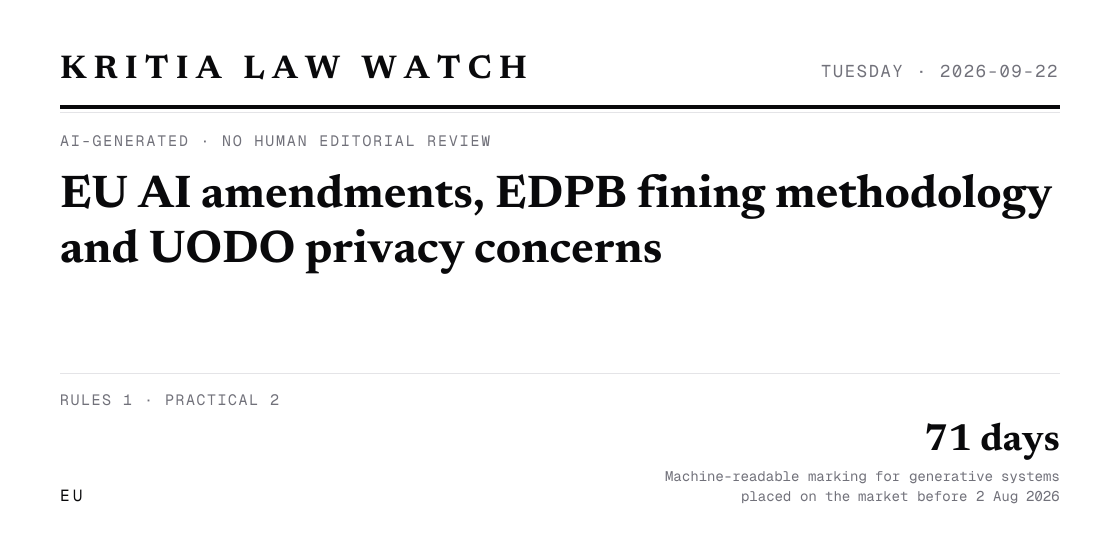
The European Commission describes AI Act amendments and implementation-related engagement, while the EDPB announces a fining methodology and final DSA-GDPR guidelines. Poland’s UODO reports a local-government debate highlighting possible data-protection, privacy and information-security risks.
01 — ENFORCEMENT
Decisions authorities and courts actually published.
No newly published decision verified today. When one lands it appears here, with the authority's own document linked — never second-hand.
02 — RULES & GUIDANCE
New or changed official text, guidance and proposals.
EDPB harmonises fining methodology and adopts final DSA-GDPR guidelines (4 minute read)
European Data Protection Board· EU
The EDPB says it adopted guidelines on applying administrative fines alongside other GDPR corrective powers, using a five-step methodology. It also adopted the final version of guidelines on the interplay between the DSA and GDPR. The fining guidelines are subject to public consultation until 13 November 2026.
Why it matters to you
For firms using AI products, the announcement identifies how DPAs should approach possible fines and other corrective measures. It does not state how any particular firm or case would be assessed.
03 — PRACTICAL
Worth doing, or worth the time to read.
European AI Office page updated with AI Act amendments and implementation engagement (3 minute read)
European Commission / European AI Office· EU
The European Commission’s page says the AI Omnibus was adopted in June 2026 and introduced targeted amendments to the AI Act; those amendments entered into force on 27 July. It also says engagement with businesses and other stakeholders started before the AI Act entered into force, allowing businesses to plan ahead and prepare for full implementation.
Why it matters to you
The page points firms to engagement activities and describes the Commission’s account of amendments and preparation. It does not by itself specify what any particular AI product or business must do.
UODO discusses AI use in local government and data-protection risks (3 minute read)
Polish Personal Data Protection Office (UODO)· EU
UODO reports a discussion at the Polish Towns Forum about using AI in local government. It says such use could improve and speed up resident services, particularly where smaller units have limited human and financial resources. It also says such a solution may threaten personal-data protection, privacy and information security.
Why it matters to you
The item records risks raised by UODO in the local-government setting, including questions about privacy, information security and what data to process. It does not state that every business use of AI presents those risks.
04 — THE WIDER VIEW
Written about the rules, not by the people who make them.
Nothing worth your time today.
05 — COUNTDOWN
71days · 2026-12-02
Machine-readable marking for generative systems placed on the market before 2 Aug 2026.
What this isn’t
News about the law, not legal advice, and not an assessment of your business. Items marked Analysis are someone’s view of the rules, not the rules. Whether a duty applies to you depends on what you actually do. The public guides explain the general rules and link their primary sources.
Get this each publishing day
Free by email, with no account and no card. About a minute to read, every reported item linked to its source.