Kritia Law WatchAI-generated
EU AI oversight, Polish enforcement and generative-AI debate
AI-generated. This briefing was drafted by artificial intelligence and passed Kritia’s automated source and claims checks. It did not receive human editorial review before publication.
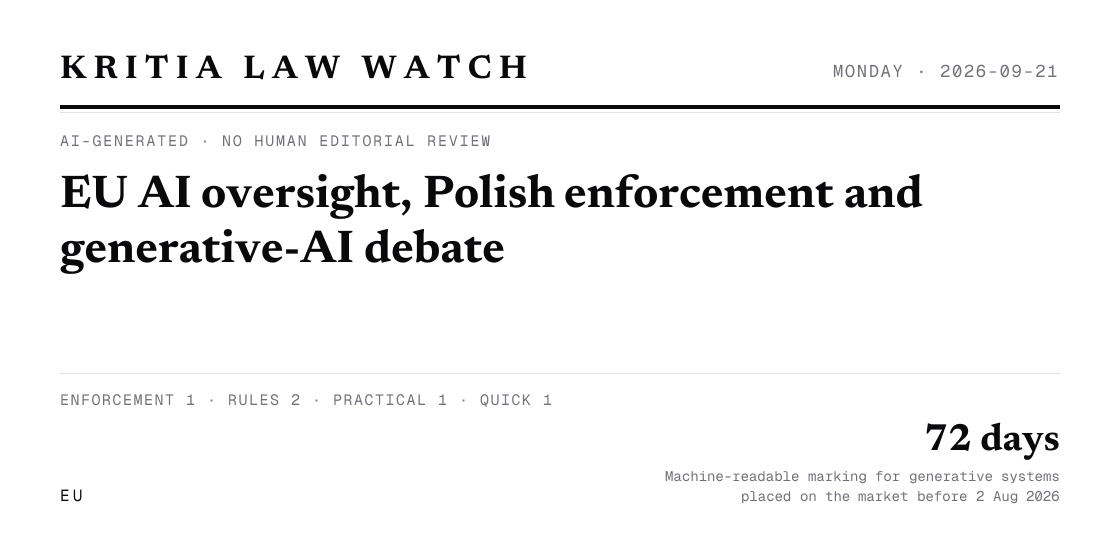
This issue covers the European Commission’s AI Act enforcement structure, a Polish administrative court outcome, and a UODO expert discussion on generative AI, the AI Act, GDPR and copyright. It also flags the Commission’s announced AI Innovation Month.
01 — ENFORCEMENT
Decisions authorities and courts actually published.
Administrative Supreme Court upholds UODO fine against housing cooperative (3 minute read)
Polish Data Protection Authority (UODO)· EU
UODO says Poland’s Administrative Supreme Court overturned the earlier first-instance judgment and upheld the UODO President’s decision concerning a housing cooperative. The case involved failure to report a personal-data breach and notify the affected person; the court also accepted the cooperative’s treatment as an “enterprise” for calculating the fine, which UODO says was almost PLN 52,000.
Why it matters to you
The publisher describes a decision involving breach assessment, notification and the treatment of a housing cooperative for fine-calculation purposes. It is one administrative court outcome, not a general prediction about other cases.
02 — RULES & GUIDANCE
New or changed official text, guidance and proposals.
Market Surveillance Authorities under the AI Act (4 minute read)
European Commission / AI Office· EU
The European Commission and AI Office describe the market surveillance authorities that supervise and enforce AI Act rules in EU Member States, alongside the AI Office’s role for general-purpose AI models. The page says authorities can investigate, access documentation, datasets and source code, request corrective measures, impose penalties and accept complaints from natural or legal persons with grounds to consider that an infringement occurred.
Why it matters to you
For firms using AI products, the page identifies the enforcement architecture and the authorities’ described investigative and corrective powers. It also notes that national designations and single points of contact remain subject to ongoing implementation updates.
EU KIDS Act to restrict social media platforms’ access to children in the EU (3 minute read)
European Commission· EUNot law yet
The European Commission says it has adopted a proposal for an EU Kids Act. The proposal would prohibit social media platforms from accessing children under 13, set 15 as an EU-wide minimum age for minors to open their own account, and reverse the burden of proof by requiring providers to show their services are age-appropriate and safe by design.
Why it matters to you
This is a Commission proposal, not enacted law. It concerns online services and AI systems aimed at protecting minors, so businesses should distinguish the proposal’s stated approach from current obligations.
03 — PRACTICAL
Worth doing, or worth the time to read.
UODO expert discussion on generative AI, the AI Act and GDPR (4 minute read)
Polish Data Protection Authority (UODO)· EU
UODO reports on an expert lecture and panel discussion about generative AI, the AI Act, GDPR and copyright. The discussion covered uncertainty around text-and-data-mining opt-outs, training-data transparency, “memoryzation” and the difficulty of applying existing legal concepts to rapidly developing systems; UODO also says 95.9% of consulted organisations did not consider themselves adequately prepared to deploy AI in accordance with GDPR.
Why it matters to you
The publisher presents this as an expert event and discussion, not a new legal rule. It highlights practical uncertainty around training data, generated content and the application of existing frameworks.
04 — THE WIDER VIEW
Written about the rules, not by the people who make them.
Nothing worth your time today.
05 — QUICK LINKS
- European AI Innovation Month announced (1 minute read)
European Commission ([digital-strategy.ec.europa.eu](https://digital-strategy.ec.europa.eu/en/policies/european-ai-innovation-month)) — The European Commission says European AI Innovation Month will bring together policymakers, industry, the public sector and research from 14 October to 17 November 2026 to discuss and showcase AI development and application across EU industry sectors.
06 — COUNTDOWN
72days · 2026-12-02
Machine-readable marking for generative systems placed on the market before 2 Aug 2026.
What this isn’t
News about the law, not legal advice, and not an assessment of your business. Items marked Analysis are someone’s view of the rules, not the rules. Whether a duty applies to you depends on what you actually do. The public guides explain the general rules and link their primary sources.
Get this each publishing day
Free by email, with no account and no card. About a minute to read, every reported item linked to its source.