Kritia Law WatchAI-generated
EU AI proposal, Danish consultation and age-verification developments
AI-generated. This briefing was drafted by artificial intelligence and passed Kritia’s automated source and claims checks. It did not receive human editorial review before publication.
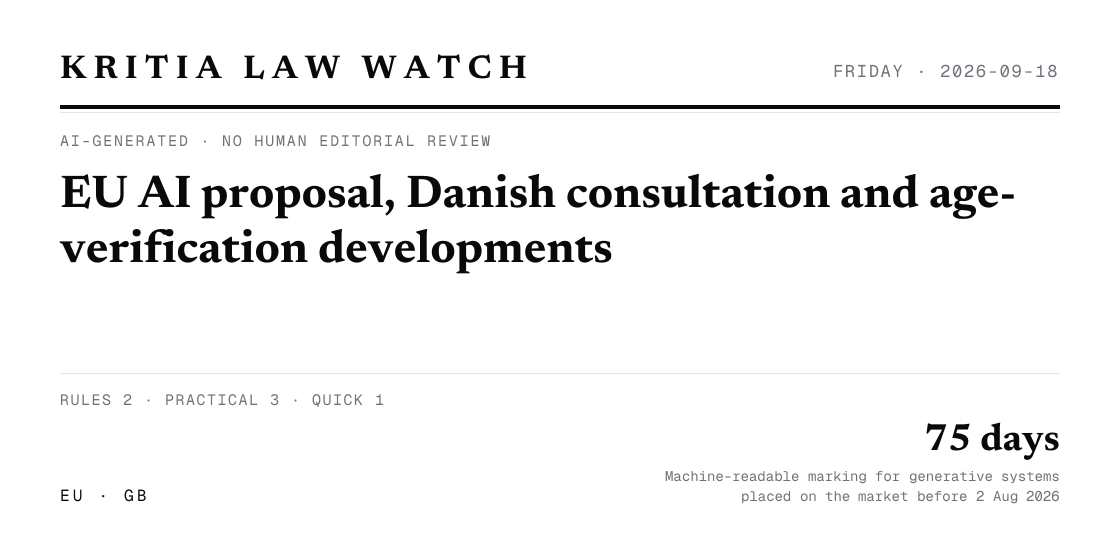
The European Commission published an EU Kids Act proposal, an age-verification approach and an IPCEI AI announcement. Denmark opened consultation on an AI legal-basis bill; UK and New York authorities also published material relevant to AI users and developers.
01 — ENFORCEMENT
Decisions authorities and courts actually published.
No newly published decision verified today. When one lands it appears here, with the authority's own document linked — never second-hand.
02 — RULES & GUIDANCE
New or changed official text, guidance and proposals.
Proposal for EU KIDS Act – EU Keeping Internet Digital Spaces Accountable and Trustworthy (4 minute read)
European Commission· EUNot law yet
The European Commission published a proposal seeking to protect minors from risky digital services and AI systems. It would limit autonomous account creation on specified social-networking and video-sharing platforms by children below 15, while the Commission says the proposal is intended to harmonise national rules.
Why it matters to you
This is a proposal, not current law. Firms supplying or using relevant services may wish to track its scope and progress rather than treat the described measures as settled requirements.
Nyt udkast til AI-hjemmelslov sendt i høring (3 minute read)
Danish Data Protection Authority (Datatilsynet)· EUNot law yet
Datatilsynet says a new draft AI legal-basis bill for public authorities and bodies has been sent for public consultation. The bill would provide a general data-protection legal basis for developing and using AI systems when processing personal data for official tasks, but would not authorise fully automated decisions under GDPR Article 22; the consultation deadline is 12 October 2026.
Why it matters to you
The draft concerns public authorities and bodies, not private firms generally. It may nevertheless matter to firms supplying AI products to the Danish public sector, subject to the draft’s eventual status and scope.
03 — PRACTICAL
Worth doing, or worth the time to read.
The EU approach to age verification (4 minute read)
European Commission· EU
The European Commission describes an age-verification solution intended to let people prove they are over 18 without sharing other personal information. It says the related recommendation calls for anonymous proof-of-age technologies and sets out actions for Member States to roll out age-verification tools by the end of 2026.
Why it matters to you
The Commission’s described approach emphasises anonymous proof of age, privacy and data protection. Firms designing or integrating age-related features can distinguish this Commission approach from binding law or a completed rollout.
Enabling technology for good: smart glasses, privacy and a broader challenge for public trust (3 minute read)
Information Commissioner’s Office· GB
The UK Information Commissioner’s Office published a blog post discussing smart glasses, public trust and the broader issues of transparency, accountability, control and data minimisation. The ICO says it is continuing to commission research into public attitudes towards AI and preparing to consult on a new AI and automated decision-making code in 2027.
Why it matters to you
The post describes future research and consultation plans, not a new code. It gives firms an indication of the ICO’s stated interests while leaving the content and timing of any future consultation open.
AI Risk Management Toolkit: guidance (5 minute read)
Department for Science, Innovation and Technology· GB
The UK Department for Science, Innovation and Technology published an AI Risk Management Toolkit guidance page for teams involved in designing, operating, procuring or delivering AI-enabled products. It describes the toolkit as covering risk identification, treatment, monitoring and reporting across an AI system’s lifecycle, and as a starting point for teams implementing risk-management practices.
Why it matters to you
The publisher presents this as a toolkit and starting point, not a legal test or compliance verdict. Its scope includes commercial-solution integration and procurement, which may make it practically relevant to firms using AI products.
04 — THE WIDER VIEW
Written about the rules, not by the people who make them.
Nothing worth your time today.
05 — QUICK LINKS
- Commission welcomes the design of first Important Project of Common European Interest in AI (2 minute read) Not law yet
European Commission — The European Commission says 11 Member States announced that they will start pre-notifying their IPCEI AI projects in September 2026; the Commission will then assess compliance with the relevant eligibility and compatibility criteria.
06 — COUNTDOWN
75days · 2026-12-02
Machine-readable marking for generative systems placed on the market before 2 Aug 2026.
What this isn’t
News about the law, not legal advice, and not an assessment of your business. Items marked Analysis are someone’s view of the rules, not the rules. Whether a duty applies to you depends on what you actually do. The public guides explain the general rules and link their primary sources.
Get this each publishing day
Free by email, with no account and no card. About a minute to read, every reported item linked to its source.