Kritia Law WatchAI-generated
EU neuro-AI statement and CNIL’s EUR 300,000 EXTIA decision
AI-generated. This briefing was drafted by artificial intelligence and passed Kritia’s automated source and claims checks. It did not receive human editorial review before publication.
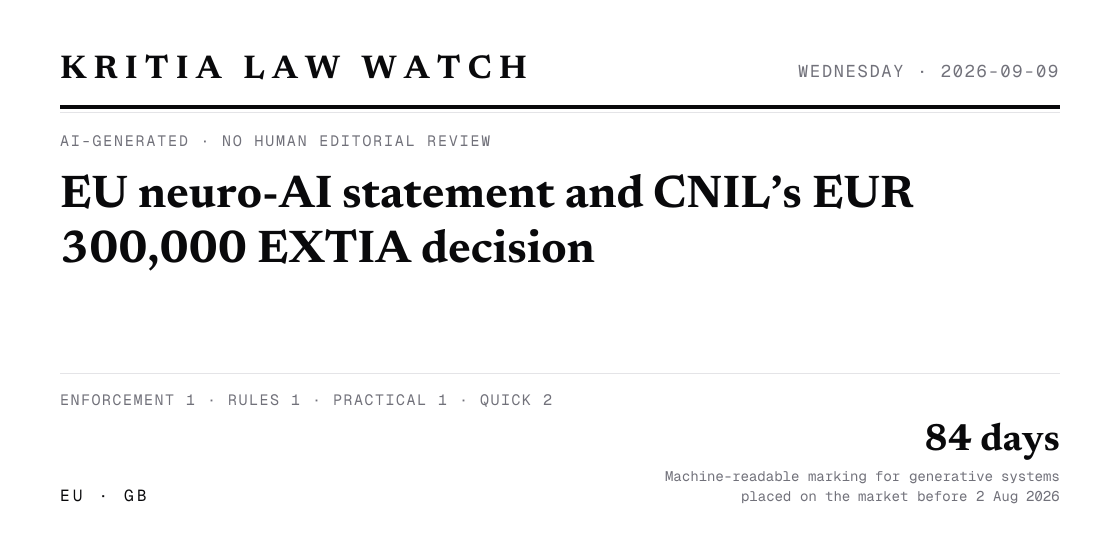
This issue covers a European Commission statement on neuro-AI governance, a CNIL enforcement decision, and practical and policy developments affecting AI deployment.
01 — ENFORCEMENT
Decisions authorities and courts actually published.
CNIL fines EXTIA EUR 300,000 for failure to respect individual rights (3 minute read)
French Data Protection Authority (CNIL)· EU
CNIL says its restricted committee imposed a EUR 300,000 fine on EXTIA for failures involving erasure requests and information about their outcomes. It says 12 erasure requests were not processed, while 166 people were not informed of the action taken and 27 received information late, with delays of up to several months. CNIL also says EXTIA took remedial measures during the procedure.
Why it matters to you
For businesses using AI and handling personal data, the decision illustrates the operational importance CNIL places on processing and communicating the outcome of individual rights requests.
02 — RULES & GUIDANCE
New or changed official text, guidance and proposals.
Experts call for a new approach to Neuro-AI governance (2 minute read)
European Commission — Directorate-General for Research and Innovation· EUNot law yet
The European Commission reports that the European Group on Ethics has released a statement, “Governing Neuro-AI: Towards an Infrastructure Approach.” The statement calls for a systemic approach covering neurodata, related inferences, infrastructure, fundamental rights and public-interest governance. Its recommendations include stronger protection for neurodata and a targeted assessment of the EU framework governing neuro-AI systems.
Why it matters to you
This is an expert statement, not a new law. It signals areas the EGE considers relevant to future discussion of neuro-AI, including data protection, rights and regulatory assessment.
03 — PRACTICAL
Worth doing, or worth the time to read.
AI Risk Management Toolkit: guidance (4 minute read)
UK Department for Science, Innovation and Technology· GB
The UK Department for Science, Innovation and Technology describes this as guidance relevant to deploying AI solutions. Its discussion covers legal and regulatory compliance, transparency, fairness, accountability, contestability, technical robustness, security, and risks to people and the environment. It also describes reassessing risks after model updates or releases and continuously monitoring live services.
Why it matters to you
For an EU business using AI products, the toolkit may offer a structured reference for discussing deployment risks, while remaining UK guidance rather than an EU legal instrument.
04 — THE WIDER VIEW
Written about the rules, not by the people who make them.
Nothing worth your time today.
05 — QUICK LINKS
- Nine CEE countries sign Prague Declaration on Artificial Intelligence (1 minute read)
Croatian Ministry of Justice, Public Administration and Digital Transformation — Croatia’s ministry says nine Central and Eastern European EU member states committed to closer AI-policy coordination, interconnected computing infrastructure and systematic sharing of practice through the Prague Declaration. - How emerging privacy technologies could reshape law enforcement (1 minute read)
European Commission — Joint Research Centre — A JRC–Europol study announcement identifies AI among emerging technologies relevant to future law-enforcement work, including pattern detection, identifying connections in complex information and detecting manipulated media.
06 — COUNTDOWN
84days · 2026-12-02
Machine-readable marking for generative systems placed on the market before 2 Aug 2026.
What this isn’t
News about the law, not legal advice, and not an assessment of your business. Items marked Analysis are someone’s view of the rules, not the rules. Whether a duty applies to you depends on what you actually do. The public guides explain the general rules and link their primary sources.
Get this each publishing day
Free by email, with no account and no card. About a minute to read, every reported item linked to its source.